A standing process, running every quarter, on its own

Oracle's release cadence is a cycle, not a one off event. What handles it should be a standing process, not a checklist somebody dusts off four times a year.
Four stages around every update

They plan, execute and adapt around each release without a human kicking off the run. Release verified is what the four produce together, not a fifth stage.

70%
faster release validation
Oracle quarterly release
Release analysisReads the readiness document and maps each change to your configured modules
Regression runPlans and runs regression against the affected areas unattended
Risk rankingWorks through the impact and ranks it by risk to your estate
Evidence packAssembles the certified, ready to review report with evidence attached
Release verified, with the evidence trail attached and a human reviewing before sign off.

Why it does not invent a feature that is not in the release

Release analysis is only useful if it is anchored to the actual document. The platform extracts a structured feature catalogue from the Oracle readiness document at ingestion time, and effort, enablement steps and benefits stay empty unless that document stated them. Nothing is filled in from a model's general knowledge of Oracle.

Findings are then checked against your configured module list, so a change to something you do not run does not arrive as an action item. Severity is calibrated by a rules pass, because models inflate severity and a report where everything is critical gets ignored.

What runs each quarter

The same named capabilities you would compare against any other Oracle release tool.

Release impact analysis
Each Oracle change mapped against your configured module list, so changes to things you do not run never reach your backlog.
Change intelligence
Opt in versus mandatory changes separated, with the enablement steps Oracle actually documented.
Severity calibration
A rules pass corrects inflated severity, because a report where everything is critical gets ignored.
Regression suite building
Predicted at risk tests resolved into a real, reviewable suite that a human approves before it runs.
Redwood readiness
Redwood UI changes surfaced separately, since they break navigation rather than logic.
What's New catalogue
A per release feature catalogue extracted from the Oracle document, never filled in from general knowledge.

What a release validation pass looks like

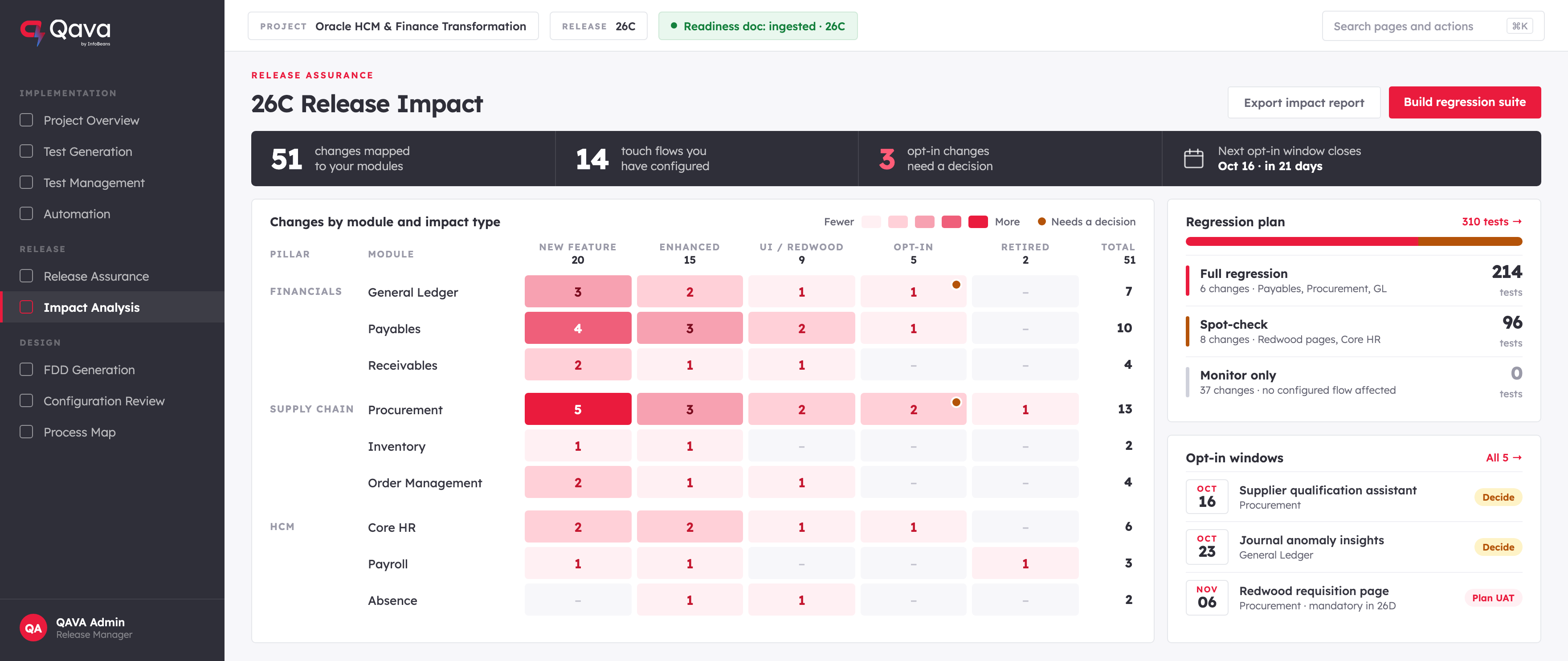
New capabilities, enhancements and retirements mapped to your modules, with the effort broken out by area.
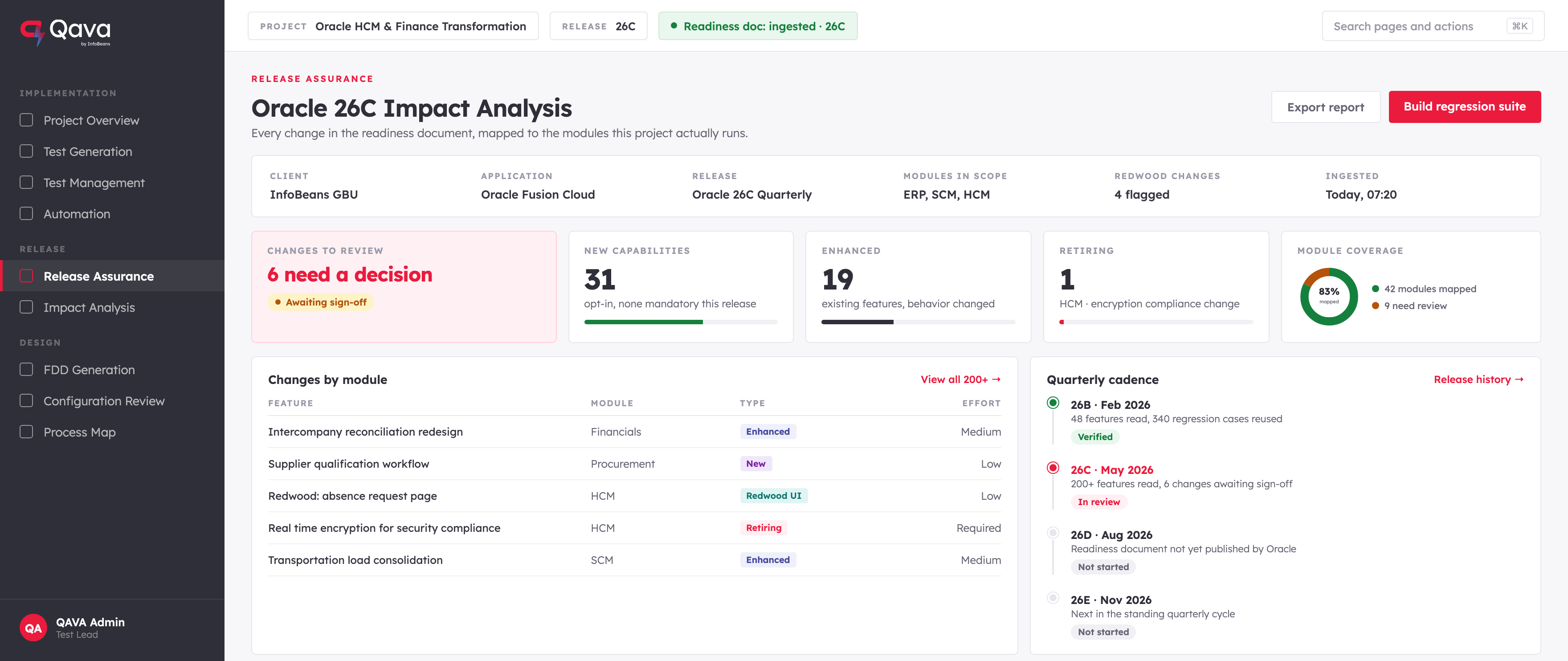
Release impact analysis screen showing new, enhanced and retiring changes broken down by module, with module coverage and where the testing effort falls
Built on delivery work, not a lab

The platform was built by the same InfoBeans Oracle practice that runs Fusion implementations. Every automation in the library came out of a real project before it was offered to anyone else.

Running against live Fusion environments

Not a prototype against sample data. The screens and figures on this site come from our own implementation projects, executing against real Fusion instances in approved test environments.

Judge it on your own release

We would rather run it on your release notes than show you a canned demo. You will see what it flags, what it misses, and where it stops and asks a human.

Nothing runs against production, and a human signs off in four places.

We never use your data to train a model, and once a project is created its data stays inside it. Execution is scoped to a test environment you approve explicitly.

Use your next release as the test
Send us the readiness document for the release you are preparing for. We will return the impact analysis and you can judge it against what your own team found.
Send us a release document Read two similar engagements