Testing that keeps up with your go live date

SIT, E2E and UAT across ERP, SCM, HCM and Transportation Management is still scripted and run by hand, one pillar at a time. This takes that over and runs it as one pipeline.
From the testing phase through to hypercare

80%
overall testing effort reduction
6,800+scripts, automated and ready to use

Seven stages run without a person kicking off each one. A human enters at sign off by design, not because the run stalled.

Cross pillar coverage, including integrations, extensions and reports: ERP, SCM, HCM and Transportation Management are usually tested in silos, so cross pillar flows, custom integrations, extensions and reports get missed. Coverage is planned across all of it together, in one pass.
From the library first: Most projects script every test from zero. Our Oracle automation library is checked before anything is generated, which turns weeks of scripting into hours.
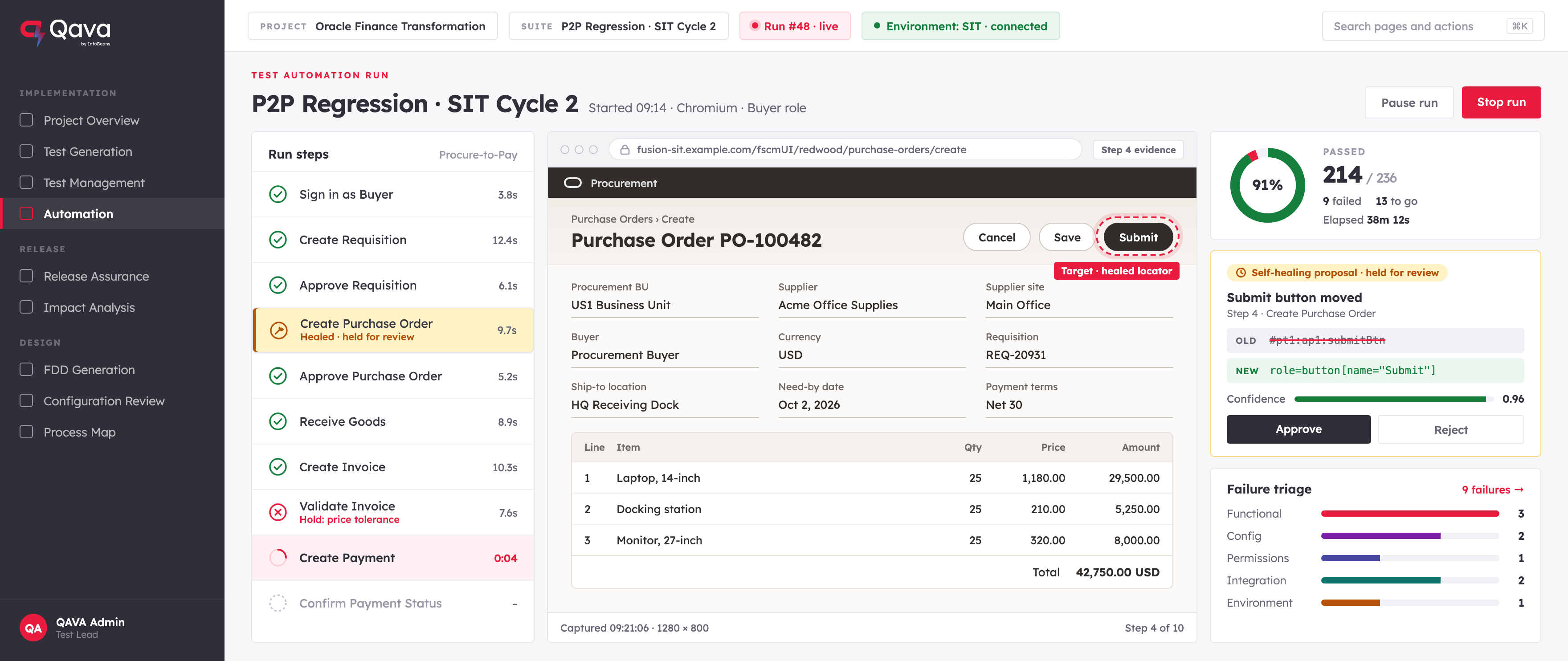
Unattended, self healing execution: Runs end to end overnight, from FDD to go live. A broken locator is rediscovered and the repair proposed rather than stopping the run.
Risk based, with a human gate: High impact flows are triaged first, but an SME still approves scope before generation and results before sign off.
Full traceability: Every executed step and test case is linked back to its FDD requirement.
InitiationImplementation reaches the testing phase and the pipeline takes over.
Coverage & libraryDecides what already exists, pulls matching scripts from our prebuilt Oracle test library, and generates only the rest.
Unattended executionRuns the full suite overnight without a person watching it, adjusting as it goes.
Failure triageRoot cause analysis on every failure, classified as a functional issue, a config issue, a permissions problem, an integration failure or an environment issue.
Closure regressionReruns the affected scripts after fixes and confirms closure, with no manual retrigger.
Business sign offStakeholders review the results and approve.
Go liveA smooth go live, then hypercare with automated daily checks running against your system.

What this looks like on a real implementation

Execution progress, pass rate, automation coverage, and failures waiting on a human, with each one already classified.
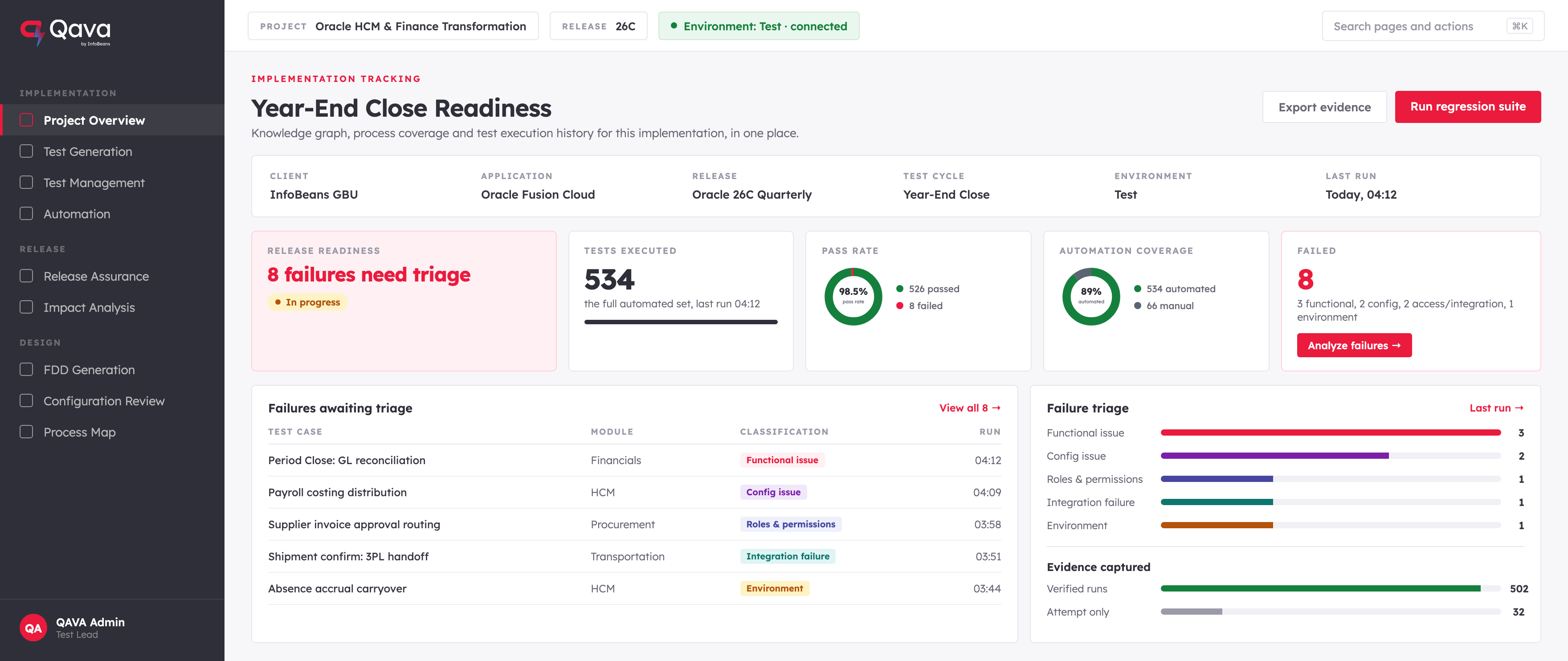
Implementation tracking screen showing 534 tests executed, 98.5% pass rate, 89% automation coverage, and eight failures classified as functional issues, config issues, roles and permissions, integration failures or environment issues

What is in the platform

Named capabilities rather than adjectives, so you can check them off against whatever else you are evaluating.

Prebuilt Oracle test library
Proven scripts across ERP, SCM, HCM and Transportation Management, reused before anything is generated.
Test discovery
Coverage planned against your configured modules and process taxonomy, not a generic checklist.
Self healing execution
A broken locator is rediscovered and the repair proposed, then held for human review before a later run trusts it.
Failure triage
Every failure classified as functional, configuration, permissions, integration or environment, so the report arrives already sorted.
Evidence and traceability
Screenshots, timings and per step results on every run, linked back to the originating requirement.
Full scope coverage
Integrations, extensions, custom reports and multistep processes like procure to pay tested alongside core flows.
Data driven runs
One approved flow executed across a table of test data, each row passing or failing on its own.
Built on delivery work, not a lab

The platform was built by the same InfoBeans Oracle practice that runs Fusion implementations. Every automation in the library came out of a real project before it was offered to anyone else.

Running against live Fusion environments

Not a prototype against sample data. The screens and figures on this site come from our own implementation projects, executing against real Fusion instances in approved test environments.

Judge it on your own release

We would rather run it on your release notes than show you a canned demo. You will see what it flags, what it misses, and where it stops and asks a human.

Nothing runs against production, and a human signs off in four places.

We never use your data to train a model, and once a project is created its data stays inside it. Execution is scoped to a test environment you approve explicitly.

Point it at one pillar and see
Pick the pillar you trust least right now. We will generate and run coverage against it and walk you through what came back.
Set up a pilot run Read two similar engagements